

Introduction
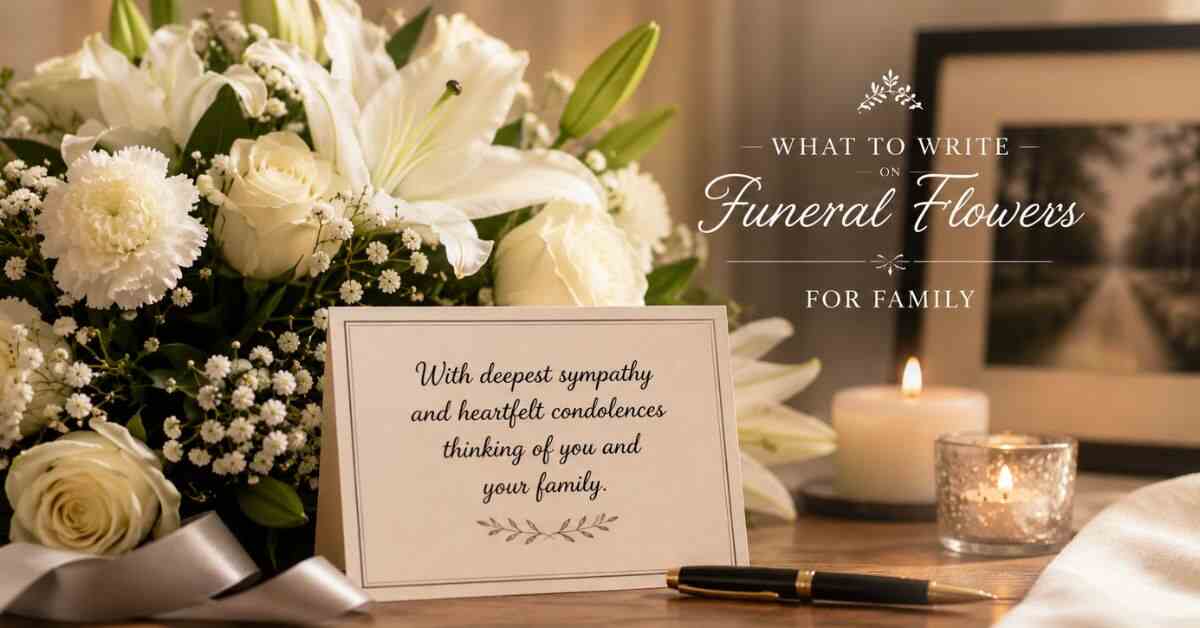
Standing in front of a florist’s card with a pen in hand is harder than it should be. Flower cards are small, usually just a few lines, and that limited space can make finding the right words feel more difficult than writing a full letter would.
Knowing what to write on funeral flowers for family means finding language that fits a specific relationship, a parent, a sibling, a grandparent, or the family as a whole, without sounding generic or rehearsed.
This page organizes flower card messages by relationship, so you can find something that actually fits who you’re honoring and who will read it. Read through the section that matches your situation, adjust it if needed, and write it with confidence instead of hesitation.
What To Write On Funeral Flowers For A Parent
“With deepest sympathy, honoring the life and memory of a parent who meant so much to this family.”
“Thinking of you and your family as you say goodbye to a mother who gave so generously.”
“With heartfelt condolences, remembering a life that touched so many people in quiet, lasting ways.”
“Honoring the memory of your parent, whose love left an impression that time won’t fade.”
“With deepest sympathy for the loss of your father, a presence that will be deeply missed.”
“In memory of a mother whose kindness and strength shaped generations within this family.”
“With sincere condolences, holding your family close as you grieve someone who gave you so much.”
Explanation:
Messages for a parent’s funeral flowers work best when they acknowledge both the individual and their lasting impact on the family. Keeping language warm but not overly personal respects that these cards are often read by extended family and guests, not only immediate loved ones.
What To Write On Funeral Flowers For A Sibling
“With deepest sympathy, honoring a sibling whose presence brought so much to this family’s story.”
“In loving memory of your brother, remembered fondly by everyone whose life he touched.”
“Thinking of you as you grieve a sister who meant so much to this entire family.”
“With heartfelt condolences, honoring the memory of someone who was truly loved as a sibling.”
“In memory of your brother, whose place in this family’s story will always remain.”
“With sincere sympathy, remembering a sister whose warmth and spirit touched everyone around her.”
“With love and condolences, remembering a life that brought so much to this family.”
“In loving memory, honoring the bond only siblings share, one that never truly ends.”
Explanation:
Sibling-focused messages work well when they acknowledge the specific bond between brothers and sisters, which often differs from other family relationships. Naming that unique connection, even briefly, makes the card feel more personal than a fully generic message.
What To Write On Funeral Flowers For A Grandparent
“In loving memory of your grandmother, remembered for the wisdom and warmth she shared.”
“With heartfelt condolences, remembering a grandparent whose presence brought comfort to so many.”
“In memory of a life well lived, honoring the grandparent this family will always cherish.”
“Honoring a grandfather whose stories, wisdom, and love will be remembered for generations.”
“With love and condolences, celebrating a life that meant so much to this entire family.”
“In loving memory of your grandparent, whose legacy lives on through everyone they loved.”
“With deepest sympathy, remembering a grandparent who will be missed by generations to come.”
Explanation:
Grandparent messages often work best when they reference legacy and generational impact, since grandparents frequently hold that specific role within a family’s story. This framing honors their broader influence, not just their individual presence.
What To Write On Funeral Flowers For The Whole Family
“Thinking of your whole family as you grieve together and support one another.”
“With heartfelt condolences to your family, holding you all close in thought.”
“Honoring your loved one and thinking of your entire family during this loss.”
“With deepest condolences to your family, hoping you find strength in each other.”
“Thinking of your family with love, honoring the life you’re all mourning together.”
“With heartfelt sympathy, holding your entire family in thought during this loss.”
“Sending comfort and strength to your family as you grieve this significant loss together.”
Explanation:
Messages addressed to an entire family work best when they acknowledge collective grief rather than singling out one relationship. This tone suits situations where the sender doesn’t know every family member personally but still wants to express genuine care.
What To Write On Funeral Flowers When Words Feel Hard To Find
“With more sympathy than words can properly express during this difficult time.”
“Simply, with love and deepest sympathy, thinking of you during this time.”
“With quiet sympathy, honoring a loss that words alone cannot fully address.”
“There’s little to say that helps right now, only that we’re here.”
“With deepest condolences, even when the right words are genuinely hard to find.”
“Simply offering our love and sympathy, knowing words can’t fully capture this loss.”
Explanation:
A particular reason these messages work is because they don’t impose meaning on a moment that doesn’t require it. Acknowledging that words feel inadequate is often more honest, and more comforting, than reaching for language that tries too hard.
What These Messages Really Mean
Funeral flower messages work best when they’re brief, sincere, and matched to the specific relationship being honored. A short card doesn’t need elaborate language; it simply needs to feel genuine and appropriate to the moment.
These messages matter because flower cards are often read publicly, alongside dozens of others, during an already overwhelming time. Clear, respectful language tends to land better than anything overly personal or lengthy in that setting.
The right message depends heavily on who’s being remembered: parent, sibling, grandparent, or the family collectively. Matching the tone to that specific relationship shows genuine thoughtfulness rather than a generic, one-size approach.
Choose whichever message fits your actual relationship to the deceased and their family, adjust a word or two if needed, and write it with confidence rather than searching endlessly for something more elaborate.
Tips For Writing Funeral Flower Messages
- Keep the message brief; flower cards have limited space and limited reading time.
- Match the tone to your actual relationship with the deceased and their famil.y
- Avoid overly personal details that might be better shared in person or by letter.r
- Include your name clearly, since flower arrangements often lack other identifying information.
- When unsure, simple and sincere always outperforms elaborate and uncertain
Common Mistakes To Avoid
- Writing something too long for the limited space a flower card actually provides
- Using overly casual language that doesn’t match the formality of the occasion
- Adding humor or personal anecdotes that don’t fit a shared, public card
- Forgetting to sign the card, leaving the sender unclear to the grieving family
- Overthinking the message so much that it delays sending the flowers at all
Why These Messages Actually Matter
A funeral flower message may be brief, but it still represents a meaningful gesture of support during a difficult time. Even a few sincere words communicate real care to a grieving family.
These messages matter because grieving families often read every card attached to every arrangement, even amid overwhelming logistics. A well-matched message shows genuine thoughtfulness rather than an afterthought.
Flower cards also serve as a lasting record for many families, kept afterward as a reminder of who showed up during their loss. A sincere message adds real value to that keepsake.
None of this requires extensive writing skill. It simply requires choosing honest, appropriately brief language that matches the relationship being honored.
Frequently Asked Questions
Yes, especially if the family may not immediately recognize your name alone. Full names help grieving families keep track of who sent what.
Yes, brief and sincere messages are completely appropriate. Acknowledging that words feel inadequate is often more genuine than overreaching.
Address the message to the family collectively rather than referencing the deceased personally, focusing on support for those grieving.
Not significantly. The same sincere, brief approach works well for both occasions, regardless of the specific format of the service.
Final Thoughts
Knowing what to write on funeral flowers for family doesn’t require elaborate language or perfect phrasing. What matters most is choosing something sincere that matches your actual relationship to the person being honored.
Pick whichever message feels closest to true for your situation, personalize it slightly if needed, and write it with confidence instead of searching endlessly for something more impressive.
A brief, genuine message on a flower card still communicates real care during an incredibly difficult time. Sometimes a few honest words are exactly enough.
At Love Theoretically, this is exactly the kind of honest, practical support we care about offering, one genuine message at a time.